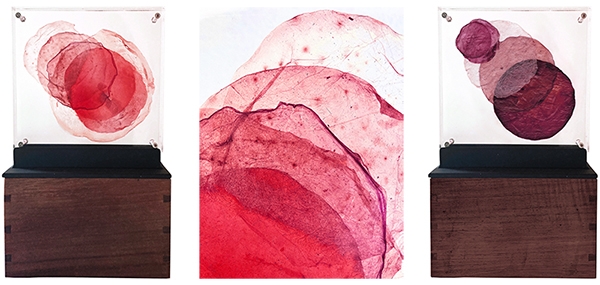
ARCA SONUS: ACETOBACTER XYLINUM DATA SONIFICATION
Arca Sonus is a work that blurs the boundaries between synthetic biology and algorithmic programming. At its core, the piece functions as a living organism that translates invisible biochemical processes into a tangible sonic experience. Acetobacter Xylinum, known for its ability to synthesize bacterial cellulose, acts as the primary composer of the work. By integrating active biological variables, the sculpture ceases to be a static object and becomes a dynamic system.
The growth of biomass, fluctuations in glucose levels, and variations in pH inform the parameters that dictate the evolution of the piece. Through an algorithm, this data is mapped and transformed into frequencies and timbres. Thus, sound becomes the voice of bacterial metabolism.
The collage of cultures, mounted upon the soundboard, functions as a visual window into the origin of the sound, creating a direct correspondence between the texture of the cellulose and the texture of the audio.
The piece proposes a reflection on interdependence, suggesting that life—even at a microscopic level—possesses an intrinsic harmony that can be decoded through technology.
The work does not merely "reproduce" sound; it "emanates" the result of a life cycle. It converts the biological laboratory into an experimental soundstage where the artist relinquishes a portion of their creative control to the autonomy of the culture.

- Sound Composition