TIMES [PAI~] Darkness
(2017-2025)
A Polyphonic Aural Immersion Piece inspired in Darkness, a Poem by G.G.Byron.
Originally Commissioned by No Idea Festival 2017
Museum of Human Achievement / Austin, Texas.
Updated Audiovisual Version 2025
An Audiovisual Eulogy for the Digital Age
TIMES [PAI~] is a 3D drawing animation that reflects on the "dark times" of the 21st century—a period marked by the systemic erosion of human compassion and the fragmentation of collective consciousness. Inspired by Lord Byron’s 1816 poem Darkness, the piece reimagines his apocalyptic vision not as a celestial event, but as a digital eclipse. In this work, the "bright sun" is extinguished by the sterile glow of alternate realities, where sanity is traded for the comfort of a virtual vacuum.
The visual environment is constructed through 3D drawing, creating a space that feels both architectural and ethereal. Unlike traditional animation, the hand-drawn lines within a three-dimensional depth produce a jittery, nervous energy—a psyche on the verge of collapse. As the animation progresses, recognizable human forms dissolve into geometric abstractions and data streams, symbolizing the migration of the soul into a cold, digitized afterlife.
The sound composition is an integral, physical force within TIMES, designed as an ever-falling soundscape that mirrors the moral and social decay of our era.
The foundation of the score is inspired on the Shepard Tone—a psychoacoustic illusion of a sound that descends infinitely in pitch. This creates a state of permanent vertigo, representing the "endless scroll" and the relentless fall of human sanity. Emerging from this drone is a voice reciting Byron’s text.
A prepared guitar provides a cold, percussive skeleton to the piece. These dissonant, dry plucks represent the rigid, unfeeling logic of the digital infrastructures that now govern our lives. Overlaid across this industrial decay are bowed strings. Utilizing sul ponticello techniques, the strings produce a strained, whistling timbre.
The piece asks the viewer to confront the cost of our digital exodus. By marrying Byron’s Romantic nihilism with modern glitch aesthetics and a collapsing soundscape, the piece creates a space for the viewer to mourn the fall of humanity—and perhaps, in that mourning, find the spark to reclaim it.

REACTIVE 3D DRAWING ANIMATION
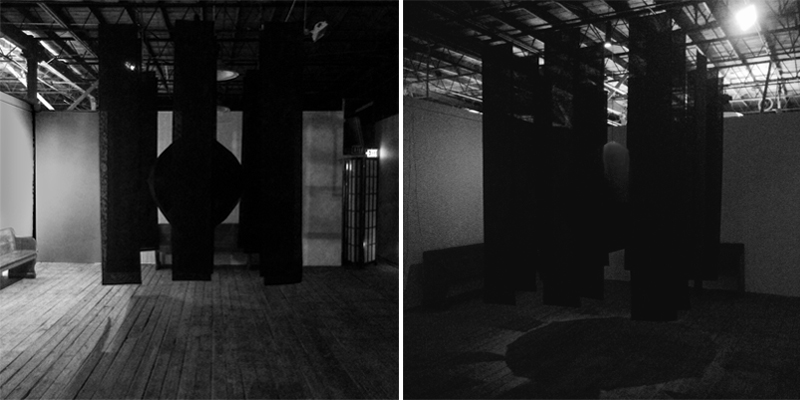
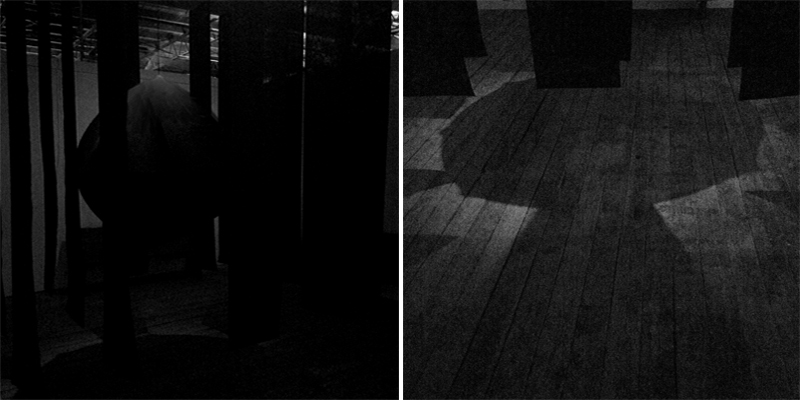
The work is experienced within a specialized installation container designed to isolate the viewer from the external world, grounding the digital void in a physical, immersive form. The 120 cm globe enclosure serves as both a visual darkroom and an acoustic isolation chamber.
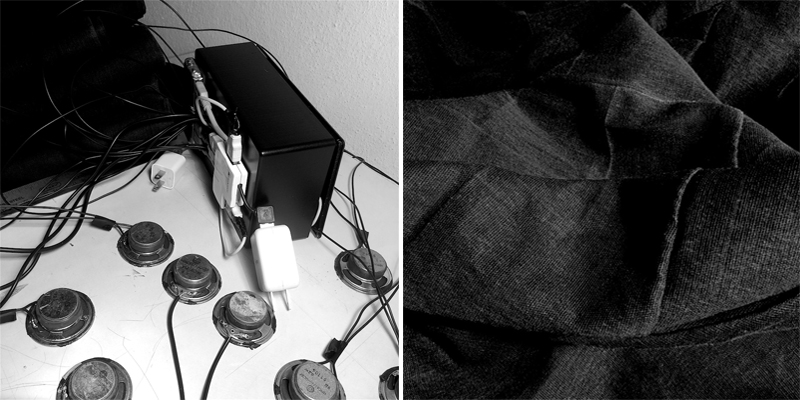
Spherical Aural Chamber: Fabric, Electronics, 8 Channel speaker System. 120 x 120 cm
Vertical Panel Space: Fabric. 250 x 300 x 262 cm
>>
D a r k n e s s
By G. G. Byron
I had a dream, which was not all a dream.
The bright sun was extinguish'd, and the stars
Did wander darkling in the eternal space,
Rayless, and pathless, and the icy earth
Swung blind and blackening in the moonless air;
Morn came and went—and came, and brought no day,
And men forgot their passions in the dread
Of this their desolation; and all hearts
Were chill'd into a selfish prayer for light:
And they did live by watchfires—and the thrones,
The palaces of crowned kings—the huts,
The habitations of all things which dwell,
Were burnt for beacons; cities were consum'd,
And men were gather'd round their blazing homes
To look once more into each other's face;
Happy were those who dwelt within the eye
Of the volcanos, and their mountain-torch:
A fearful hope was all the world contain'd;
Forests were set on fire—but hour by hour
They fell and faded—and the crackling trunks
Extinguish'd with a crash—and all was black.
The brows of men by the despairing light
Wore an unearthly aspect, as by fits
The flashes fell upon them; some lay down
And hid their eyes and wept; and some did rest
Their chins upon their clenched hands, and smil'd;
And others hurried to and fro, and fed
Their funeral piles with fuel, and look'd up
With mad disquietude on the dull sky,
The pall of a past world; and then again
With curses cast them down upon the dust,
And gnash'd their teeth and howl'd: the wild birds shriek'd
And, terrified, did flutter on the ground,
And flap their useless wings; the wildest brutes
Came tame and tremulous; and vipers crawl'd
And twin'd themselves among the multitude,
Hissing, but stingless—they were slain for food.
And War, which for a moment was no more,
Did glut himself again: a meal was bought
With blood, and each sate sullenly apart
Gorging himself in gloom: no love was left;
All earth was but one thought—and that was death
Immediate and inglorious; and the pang
Of famine fed upon all entrails—men
Died, and their bones were tombless as their flesh;
The meagre by the meagre were devour'd,
Even dogs assail'd their masters, all save one,
And he was faithful to a corse, and kept
The birds and beasts and famish'd men at bay,
Till hunger clung them, or the dropping dead
Lur'd their lank jaws; himself sought out no food,
But with a piteous and perpetual moan,
And a quick desolate cry, licking the hand
Which answer'd not with a caress—he died.
The crowd was famish'd by degrees; but two
Of an enormous city did survive,
And they were enemies: they met beside
The dying embers of an altar-place
Where had been heap'd a mass of holy things
For an unholy usage; they rak'd up,
And shivering scrap'd with their cold skeleton hands
The feeble ashes, and their feeble breath
Blew for a little life, and made a flame
Which was a mockery; then they lifted up
Their eyes as it grew lighter, and beheld
Each other's aspects—saw, and shriek'd, and died—
Even of their mutual hideousness they died,
Unknowing who he was upon whose brow
Famine had written Fiend. The world was void,
The populous and the powerful was a lump,
Seasonless, herbless, treeless, manless, lifeless—
A lump of death—a chaos of hard clay.
The rivers, lakes and ocean all stood still,
And nothing stirr'd within their silent depths;
Ships sailorless lay rotting on the sea,
And their masts fell down piecemeal: as they dropp'd
They slept on the abyss without a surge—
The waves were dead; the tides were in their grave,
The moon, their mistress, had expir'd before;
The winds were wither'd in the stagnant air,
And the clouds perish'd; Darkness had no need
Of aid from them—She was the Universe.
<>